JB Systems Media and Tech Covering the High-Tech Semi-Electronics-Systems Industries

This year’s Embedded World saw chip makers rising to the challenges presented by new IoT applications.
By Sally Ward-Foxton, European Correspondent
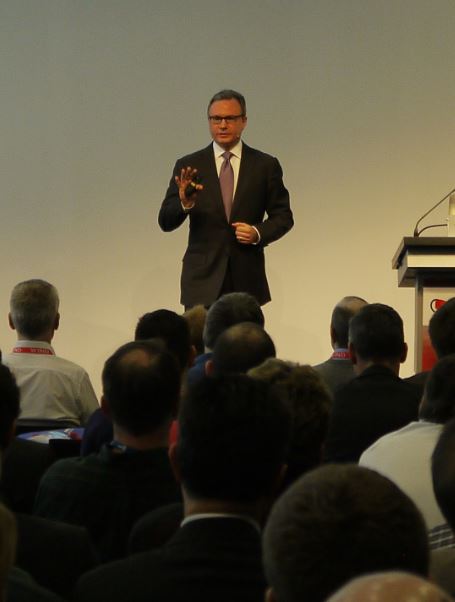
“There’s a new paradigm about what the Internet of Things means,” said Tyson Tuttle, CEO of Silicon Labs, outlining his vision for how future technologies will meet the challenges of the Internet of Things in his keynote address at Embedded World 2015 in Nuremberg, Germany (figure 1). Tuttle described how semiconductor devices will be optimised differently, and that the tradeoffs between energy consumption, functionality, integration, cost level, connectivity will necessarily change over time.
“You are going to have to have solutions that are smaller, or to work on a lower energy budget, or maybe work on a lower duty cycle, or a more limited amount of functionality,” he said. “But I think like the smartphone, this is also going to be impacted by Moore’s law… you’re going to have more functionality for the same amount of energy, you’re going to be driving the cost, you’re going to be increasing the integration level or the number of sensors.”
Wearable Sensor Fusion
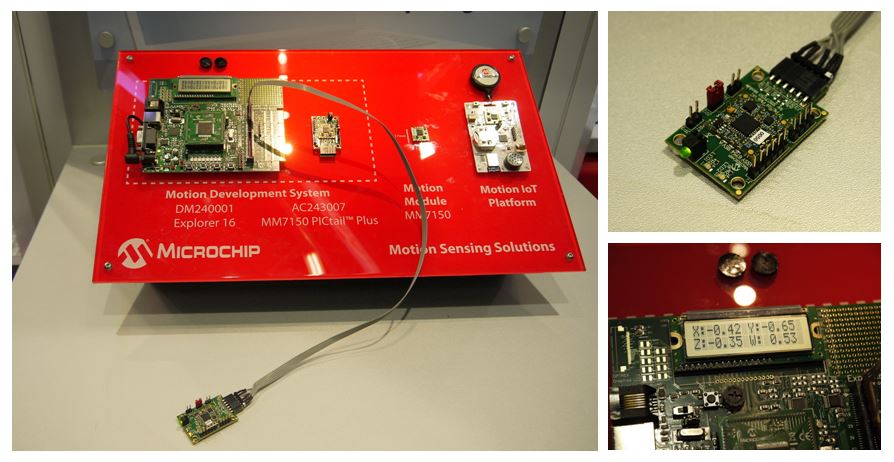
Microchip showed off the new MM7150 motion module which makes it easy to add motion and position capability to designs like battery powered wearables. All the maths is done for you by the SSC7150 motion coprocessor, which filters, compensates and fuses the raw 9-axis sensor data from Bosch’s accelerometer, magnetometer and gyroscope (figure 2).
Wilson described a popular business application for this module, the ‘Connected Cow’ (figure 3), in which an activity tracker in a collar tracks dairy cows’ movement to monitor their health in order to help maximise milk production. Activity data is uploaded to the cloud daily for analysis as cows pass a gateway in their barn. If cows are not moving much, that could indicate illness, and apparently standing still for four to five seconds several times an hour indicates the cow’s most fertile period.

Smarter Factories
Hoping to target the vast untapped sector of Industrial 4.0 and the smart factory is microcontroller specialist Renesas. Amongst the demos on their booth was a setup showing the company’s RZ/T industrial motor control device (figure 5) for real-time applications. This part comes in a single core version for motor control, or a dual core version for motor control with Ethernet connectivity.

“The RL78I1D is designed especially for detectors. A detector doesn’t need to be a real time application, it can spend a second or more asleep and then be triggered by an interrupt,” explained Andy Harding, Senior Manager for Core Marketing at Renesas. “When it’s triggered, current consumption jumps, and if it takes too long to stabilise, the device consumes more energy… the RL78I1D has industry leading wake up time.”

The smart factory was at the heart of Maxim’s reference design demo too. The company showed an IO-link RTD temperature probe, commonly used in industry, with a reference design for an RTD-to-digital converter plus an IO-Link transceiver and software stack.
Infineon used Embedded World to announce an update to its free DAVE (Digital Application Virtual Engineer) development platform for the XMC1000 and XMC4000 industrial 32-bit MCU series. The platform allows developers to combine reusable code segments, known as DAVE apps, to speed up application development. The new version boasts an improved GUI and some new apps, like power conversion apps for all the most notable topologies.
“If you liked DAVE 3, you will love DAVE 4,” says Maurizio Skerlj, head of Infineon’s industrial microcontroller business. “We added graphical pin assignments with automatic suggestions, plus low level drivers, so every peripheral has a low level driver which enables developers to directly control the peripherals in a very precise way. On top of that, the apps are more flexible, in DAVE 4 you can mix Infineon developed applications with applications that you can develop on your own using the software developer kit.”
Version 4 of DAVE is in Beta today but the full production version will be ready in July 2015.
Low Power Communications
TI unveiled a new ultra-low power wireless MCU platform for energy-harvesting applications as part of its SimpleLink portfolio. The SimpleLink ultra-low power platform supports various RF standards and proprietary modes up to 5Mbps. The first two devices available are the CC2630 for 6LoWPAN and ZigBee in wearables and beacons, and the CC2650 for Bluetooth Smart, 6LoWPAN,ZigBee and RF4CE in LED lighting control and other smart home applications. The next two, the CC1310 for Sub-GHz and the CC2620 for RF4CE, will come later in 2015.
“We have been working on this for many, many years,” says Oyvind Birkenes, General Manager for Wireless Connectivity Solutions at TI (figure 7). “It’s architected from the ground up and we even have a new process technology that’s dedicated to this type of ultra-low power devices.

Silicon Labs made several announcements regarding low power wireless at Embedded World. These included new Blue Gecko Bluetooth Smart SoCs and modules (available in Q3 and Q2, respectively) which use Bluetooth hardware and software from recent European acquisition Bluegiga.
A new wireless 32-bit micro line, EZR32, includes proprietary Sub-GHz communication for factory automation and metering in the European market. It’s essentially a combination of the company’s low power 32-bit architecture and a line of Sub-GHz transceivers from their EZ Radio family.
Silicon Labs also revealed a new 8-bit MCU platform, the EFM8 Bee family (figure 8).
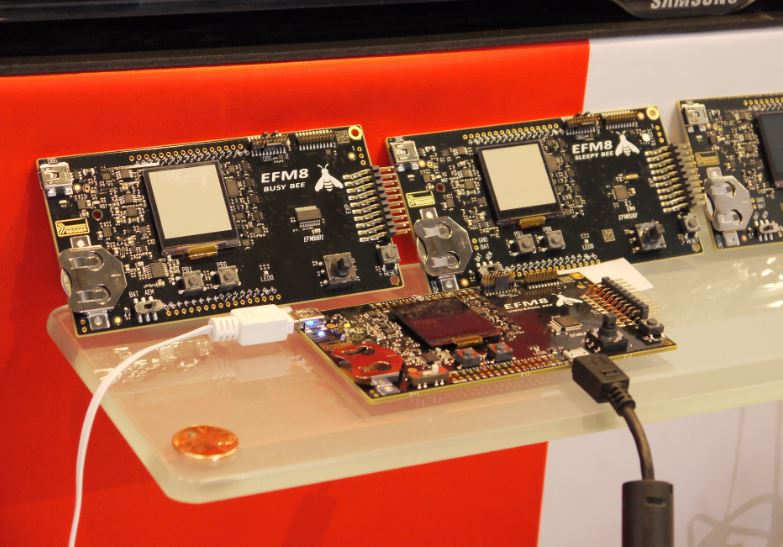
The series includes a general purpose line called Busy Bee for industrial customers, an ultra-low power version called Sleepy Bee, which sleeps for a large proportion of the time to save power, and a USB compatible version called Universal Bee. Cooley also mentioned a forthcoming addition called Laser Bee, for high end analogue and optical networking applications.
Development Made Easy
Notable dev kit launches targeting the IoT came from ARM and Intel.
ARM launched an Ethernet edition of its mbed IoT Starter Kit, which channels data from end nodes directly to IBM’s Bluemix cloud platform. The idea is to enable the easy development of new applications by offering a secure sensor environment coupled with cloud services. The kit itself comprises a Freescale dev board (including ARM Cortex-M4 CPU) together with a sensor IO application shield. It offers Ethernet connectivity today, but future kits may offer cellular, WiFi and Thread, say ARM.
Intel’s new IoT dev kit, targeted at hobbyists and entrepreneurs, is now out of Beta and includes the company’s Galileo and Edison boards, with many compatible shields, sensors and actuators available. It comes with support for various IDEs so you can program in C/C++, JavaScript, Arduino or Wyliodrin (Galileo only) and includes cloud based analytics for the gathered sensor data. Also available for the boards on a free trial basis is Intel System Studio for IoT, a tool suite for easy development, testing and optimisation of IoT applications.
Discover more from JB Systems Media and Tech
Subscribe to get the latest posts sent to your email.