JB Systems Media and Tech Covering the High-Tech Semi-Electronics-Systems Industries

Intel’s new Curie and the Freescale-enabled ARM-based WaRP give developers solid options in this burgeoning market.
By Joe Desposito, Senior Editor
Wearable technology proved a strong force at the International CES in January, not only by showing a plethora of wearables on the show floor, but also by the announcement of a new wearables platform from Intel and an Innovation award for a Freescale-enabled platform.
During his Keynote speech at CES, Intel CEO Brian Krzanich announced the Intel Curie wearables platform. About the size of a small button, the Intel Curie module is a complete low-power solution designed for companies interested in developing wearable technology solutions. At its core is Intel’s first purpose-built wearable SoC, the Intel Quark SE SoC, which can run for extended periods from a coin-sized battery (see Figure 1).

The module is scheduled to ship in the second half of this year and includes the low-power, 32-bit Intel Quark SE SoC, a Bluetooth low-energy radio, 384kB Flash memory, 80kB SRAM, a low-power integrated DSP sensor hub with a proprietary pattern matching accelerator, 6-axis combo sensor with accelerometer and gyroscope, and battery charging circuitry (PMIC).
“This product just came fresh from our labs, so to show you that it’s working, we created a simple app,” Krzanich said to the CES audience. He then demonstrated how the button-sized Intel Curie module was measuring his steps and sending that data to an app on his smartphone. Krzanich went on to say that Intel will again sponsor the Intel Make it Wearable challenge later this year. Last year’s challenge awarded a prize of $500,000 to Christoph Kohstall and Jelena Jovanovic for the Nixie, as the first wearable camera that can fly. Nixie rests on your wrist like a bracelet, then unfolds and takes flight on cue to take a photo of you in the moment. Intel’s 2014 Make it Wearable challenge was a worldwide competition to encourage inventors to create innovative wearables using Intel’s Edison technology, a platform Intel designed specifically for wearables and Internet of Things devices.

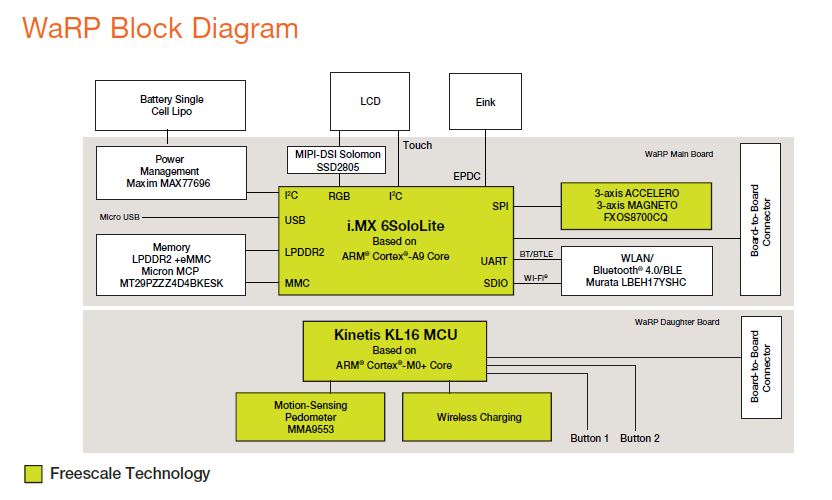
solution is engineered to dramatically streamline the design and development of exciting new wearables products. It allows designers and OEMs to go from concept to prototype as quickly as the market is changing.”
The wearables reference platform kit includes the main board, a daughter card, an LCD display battery and a micro USB cable. It is available for pre-order at www.WaRPboard.org and BoardZoo.com for $149 MSRP.
Discover more from JB Systems Media and Tech
Subscribe to get the latest posts sent to your email.