JB Systems Media and Tech Covering the High-Tech Semi-Electronics-Systems Industries
Software start-ups will dominate growth in the Internet-of-Things (IoT) as demonstrated by MindRDR’s application that combines Google Glass and Neurosky biosensor hardware.
In a recent interview, zachshelby Shelby, Director of Technology at ARM, explained that 80% of the value of the #IoT will come from software applications, while the remaining 20% of value will be split between the devices, the network, and the middleware. The analyst firm of Gartner put it this way: “Half of this activity will be new start-ups and 80 percent will be in services rather than in products.”] The fact that a sizeable portion of hardware has become a commodity is nothing new – unless it’s unique hardware such as Google Glass or the Neurosky biosensor headset (more on that shortly). But a related observation from Gartner is that, “by 2018, 50% of IoT solutions will be from start-ups less than three years old.” In other words, start-ups that don’t exist today will represent 50% of the market in just three years!
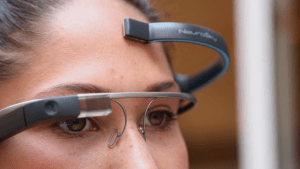
One such start-up may well be a company called MindRDR that has created a software application to control Google Glass with your thoughts. The application connects Google Glass with a device like Neurosky’s biosensor technology to monitor brain activity. One use of this application would be to allow users to take pictures and post them on Twitter or Facebook without the need for any physical interaction. In the medical field, this technology could be used to bring mobility to quadriplegics, suffers of multiple sclerosis, and other debilitating diseases.
According to the company, the user experience for taking mind-controlled pictures is centered on one’s ability to briefly focus on the task. The MindRDR application appears as a line on the bottom of the Glass’s display. As the user concentrates, the line moves up to the top, at which point it snaps the picture that the user is viewing. The captured picture is then uploaded to a social network by following a similar process.
MindRDR has chosen to freely offer their application on GitHub to encourage new applications by other developers.
It doesn’t take a mind reader or though control to realize that the next few years will see the rise of new and innovative application software. These will be exciting times!
Originally posted on my ARM community blog
Discover more from JB Systems Media and Tech
Subscribe to get the latest posts sent to your email.