JB Systems Media and Tech Covering the High-Tech Semi-Electronics-Systems Industries
Elsevier’s M2M book serves as a significant introduction to a new age of connected IoT intelligence.
By Holler, Tsiatsis, Mulligan, Karnouskos, Avesand, and Boyle
The IoT is a widely used term for a set of technologies, systems, and design principles associated with the emerging wave of Internet-connected things that are based on the physical environment. In many respects, it can initially look the same as M2M communication – connecting sensors and other devices to Information and Communication Technology (ICT) systems via wired or wireless networks.
In contrast to M2M, however, IoT also refers to the connection of such systems and sensors to the broader Internet, as well as the use of general Internet technologies. In the longer term, it is envisaged that an IoT ecosystem will emerge not dissimilar to today’s Internet, allowing things and real world objects to connect, communicate, and interact with one another in the same way humans do via the web today. Increased understanding of the complexity of the systems in question, economies of scale, and methods for ensuring interoperability, in conjunction with key business drivers and governance structures across value chains, will create wide-scale adoption and deployment of IoT solutions.
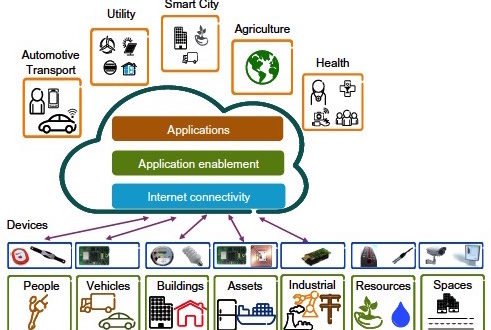
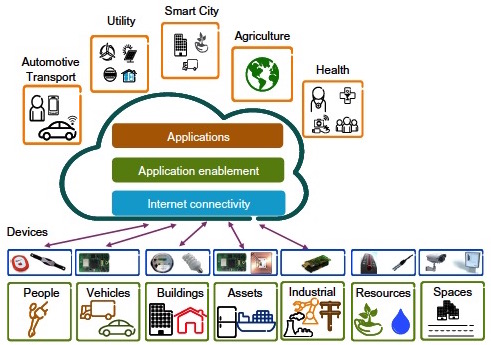
No longer will the Internet be only about people, media, and content, but it will also include all real-world assets as intelligent creatures exchanging information, interacting with people, supporting business processes of enterprises, and creating knowledge (Figure 2.3). The IoT is not a new Internet, it is an extension to the existing Internet.
IoT is about the technology, the remote monitoring, and control, and also about where these technologies are applied. IoT can have a focus on the open innovative promises of the technologies at play, and also on advanced and complex processing inside very confined and close environments such as industrial automation. When employing IoT technologies in more closed environments, an alternative interpretation of IoT could then be “Intranet of Things.”
Visions put forward (e.g. SENSEI 2013) have included notions like a global open fabric of sensor and actuator services that integrate numerous Wireless Sensor Network (WSN) deployments and provide different levels of aggregated sensor and actuator services in an open manner for application innovation and for use in not only pure monitor and control type of applications, but also to augment or enrich other types of services with contextual information. IoT applications will not only rely on data and services from sensor and actuators alone. Equally important is the blend-in of other information sources that have relevance from the viewpoint of the physical world. These can be data from Geographic Information Systems (GIS) like road databases and weather forecasting systems, and can be of both a static nature and real-time nature. Even information extracted from social media like Twitter feeds or Facebook status updates that relate to real world observations can be fed into the same IoT system. An example is in the EU FP7 project (CityPulse 2013), and this is also further described in Chapter 15, which is on Participatory Sensing (PS).
Urban Agriculture. Already today, more than 50% of the world’s population lives in urban areas and cities. The increased attention on sustainable living includes reducing transportation, and in the case of food production, reducing the needs for pesticides. The prospect of producing food at the place where it is consumed (i.e. in urban areas) is a promising example. By using IoT technologies, urban agriculture could be highly optimized. Sensors and actuators can monitor and control the plant environment and tailor the conditions according to the needs of the specific specimen. Water supply through a combination of rain collection and remote feeds can be combined on demand. City or urban districts can have separate infrastructures for the provisioning of different fertilizers. Drainage can be provided so as not to spoil crops growing on facades and rooftops of buildings, as well as to take care of any recyclable nutrients. Weather and light can be monitored, and necessary blinds that can shield and protect, as well as create greenhouse microclimates, can be automatically controlled. Fresh air generated by plants can be collected and fed into buildings, and tanks of algae that consume waste can generate fertilizers. A vision of urban agriculture is to be a self-sustaining system. Urban agriculture can be a mix of highly industrialized deployments with vertical greenhouses (Plantagon 2013), and collective efforts by individuals in apartments by the use of more do-it-yourself style equipment (Bitponics 2013).
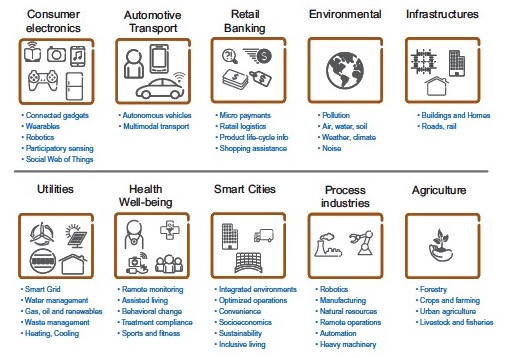
Food Safety. After several outbreaks of food-related illnesses in the U.S., the U.S. Food and Drug Administration (USFDA) created its Food Safety and Modernization Act (FSMA 2011). The main objective with FSMA is to ensure that the U.S. food supply is safe. Similar food safety objectives have also been declared by the European Union and the Chinese authorities. These objectives will have an impact across the entire food supply chain, from the farm to the table, and require a number of actors to integrate various parts of their businesses. From the monitoring of farming conditions for plant and animal health, registration of the use of pesticides and animal food, the logistics chain to monitor environmental conditions as produce is being transported, and retailers handling of food – all will be connected. Sensors will provide the necessary monitoring capabilities, and tags like radio frequency identification (RFID) will be used to identify the items so they can be tracked and traced throughout the supply chain. The origin of food can also be completely transparent to the consumers.
As can be seen by these very few examples, IoT can target very point and closed domain-oriented applications, as well as very open and innovation driven applications. Applications can stretch across an entire value chain and provide lifecycle perspectives. Applications can be for business-to-business (B2B) as well as for business-to-consumer (B2C), and can be complex and involve numerous actors, as well as large sets of heterogeneous data sources.
We will progress to see how IoT is driven by a set of diverse needs, and how based on those needs, one can arrive at a set of different needed, recurring capabilities. We will also see how different technologies emerge that will enable building IoT, as well as a generalized model, or architecture, for how to build different target IoT solutions.
 This except (from section 2.2.3) was used with permission from : “From Machine-to-Machine to the Internet of Things Introduction to a New Age of Intelligence,” by Jan Holler, Vlasios Tsiatsis, Catherine Mulligan, Stamatis Karnouskos, Stefan Avesand, and David Boyle, Elsevier – Academic Press, Oxford, 2014. http://store.elsevier.com/From-Machine-to-Machine-to-the-Internet-of-Things-Introduction-to-a-New-Age-of-Intelligence/Jan-Holler/isbn-9780124076846/
Discover more from JB Systems Media and Tech
Subscribe to get the latest posts sent to your email.