JB Systems Media and Tech Covering the High-Tech Semi-Electronics-Systems Industries
ZigBee, sensors and applications lead the way for new IoT illumination projects as explained by NXP, TI, ARM and Marvell.
By Joe Desposito, Senior Editor
Designing LED lighting used to be straightforward. Connect the LEDs, heat sink and driver and add a few other components like a power source and switches and you were off and running. Not so when designing for the IoT. IoT lighting projects also need connectivity, creativity, sensitivity and controllability, not to mention other possibilities. Let’s start with connectivity.
Connectivity usually entails a wireless or wired control network plus a gateway or bridge to the Internet. For wireless, 802.15.4 radios are most popular with designers, either ZigBee or 6LowPan. The ZigBee standard in particular has been under development for years and now boasts a variety of flavors, Zigbee LL (LightLink) (see Figure 1), Zigbee HA (Home Automation) and Zigbee SE (Smart Energy). The Zigbee 3.0 standard, which was just announced in November, unifies these standards and enables communication and interoperability among ZigBee devices for home automation, connected lighting, energy efficiency and other markets. Now, more diverse, fully interoperable solutions can be delivered by product developers and service providers.

Amit Hammer, product line manager at Texas Instruments , says TI also recommends ZigBee for the residential LED lighting market, because the mesh network capability and high interoperability fit well with residential and consumer ecosystems. But for the commercial segment, where thousands of nodes may be required, usually within close proximity, TI recommends a 6LoWPAN network based on 2.4 GHz. For the street/city segment, where thousands of nodes are required, sometimes miles from each other, TI recommends a 6LoWPAN network based on Sub-1 GHz bands.
Wired controls are still popular for industrial/commercial lighting systems, since some facilities already have a control wire along with the AC or mains power. This control wire might be 0-10V, but it is a piece of wire that can be converted to DALI (Digital Addressable Lighting Interface), KNX, or DMX (Digital Multiplex). According to Roman Budek, Product Manager for Power and Lighting Solutions at NXP there are many choices for wired controls, and some of the designs are being refreshed to take advantage of newer and cheaper processes. “NXP has updated its product portfolio to include DALI, DMX, and KNX running on the latest processors. The Intellectual Property was developed by NXP and is provided to the customer. That is a big factor in the selection process—will the semiconductor manufacturer provide the IP, or will there be a license fee?”
Whether LED lighting networks are wireless or wired, the network has to connect eventually to the Internet, so that it can be controlled from a computer, smartphone or other device from anywhere. “We recommend WiFi,” says Zheng of Marvell. “WiFi is a ubiquitous technology in homes and offices. So designers can leverage WiFi as a gateway solution. For wireless networks, they can put WiFi and ZigBee together to build a gateway. Then you literally can connect the ZigBee networks to the Internet in a home or a commercial building. Then the whole system is connected.”
Beyond connectivity, LED lighting is ripe for creativity. Mixing LED colors, for example, can change lighting from warm to cool and back again, and thus enhance mood and even health, especially in residential and office environments. This is a far cry from the original selling point of LED lighting, namely energy efficiency. NXP’s Budek says, “All indications are that consumers have grown tired of the ‘LED lighting is more efficient’ marketing promotions.” He believes that emphasizing the health benefits of LED lighting may be a way to drive up consumer demand. “Color temperature adjustment, achieved by changing multiple color LEDs inside the lamp, can mimic daylight for people suffering from circadian rhythm issues and may also improve the disposition of people affected by gloomy weather,” he said.
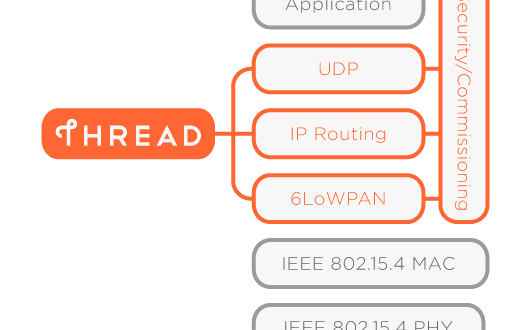
In addition to manipulating light in creative ways, designers continue to make LED lighting more “sensitive” to the environment, not just through energy efficiency, but also via sensors added to their designs. For example, occupancy sensors turn lights on and off automatically and also connect to HVAC systems to adjust heating and cooling in unoccupied rooms and offices. But this is just the tip of the iceberg. Mikko Saarnivala, Director of Technology at ARMexplains, “In the commercial building space we are seeing a lot of interest in systems where lighting controls are integrated to HVAC, access control and general property management systems. In consumer applications we are heavily involved in the definition of the new Thread connectivity standard for home area networking that enables OEMs and ODMs to create more thoroughly connected and interoperable solutions (see Figure 2). This enables them to build smarter systems, which opens up avenues and possibilities for advanced big data analytics. This then can be used to generate services that understand the needs of the consumer better and are able to adapt more closely to their habits and demands.”

Designing LED lighting for the IoT puts many more demands on designers, but also allows them to create designs that go far beyond what could be accomplished before. Marvell’s Zheng calls LED lighting a disruptive technology. When you think about all the possibilities afforded by this technology when melded with the IoT, you may tend to agree.




Discover more from JB Systems Media and Tech
Subscribe to get the latest posts sent to your email.