JB Systems Media and Tech Covering the High-Tech Semi-Electronics-Systems Industries

How will end-to-end Internet Protocol (IP) communication, enabled by the adoption of IPv6, affect the Internet-of-Things (IoT)?
By Sally Ward-Foxton, European Correspondent
Today, the internet of things often takes the form of separate networks, such as a consumers’ personal area network, connected to the internet by bridges, such as a smartphone app. Would the IoT be better off without the bridges, as an integral part of the internet as we know it?
Thomas Embla Bonnerud, Director of Product Management at Nordic Semiconductor, thinks so.
“When we started putting together our strategy for IoT, one of the fundamental discussions we had was about end-to-end IP. We asked ourselves: the internet is IP end-to-end, why should the IoT be any different?” he says. “Most of the arguments that came up were related to the practical challenges of running a complete IP stack on a small, low power, low cost SoC. If you choose not to do IP you still need to find a solution for transport, routing and end-to-end security. We concluded that end-to-end IP is extremely valuable because it allows us to use proven internet technologies for these three things.”
The present situation for wearables, with a smartphone app bridging between IP and Bluetooth Smart, is good enough for a personal area network, explains Bonnerud, but it’s not a great solution for things in the wider IoT, like non-personal things we want to be connected to the internet even when we are not around with our smartphones. For these things, a better solution is a ‘headless’ router, just like the Wi-Fi access points we know and love, but with support for Bluetooth Smart.
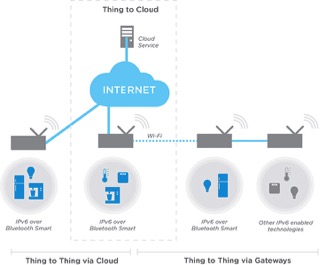
“We see an incredible interest in our IPv6 over Bluetooth Smart solution in a range of segments that traditionally not have been using Bluetooth,” Bonnerud adds. “These segments include Smart Home, Retail and Commercial and Industrial Automation. In the end, the IoT will be a massive heterogeneous network based on different connectivity technologies. We believe IPv6 over Bluetooth Smart is one of the key technologies, specifically for cost, power and size constrained applications.”
Bluetooth Implications
Behind the scenes, it’s the Bluetooth SIG’s addition of the specific profile for IP over Bluetooth – IPSP – which has extended Bluetooth’s usefulness beyond the personal area network.
“IPSP provides another mechanism for developers to realise the potential of connecting devices to the IoT with Bluetooth technologies,” explains Martin Woolley, Technical Program Manager for the Bluetooth SIG. “IPSP, in conjunction with the Bluetooth RESTful APIs and the HTTP Proxy Service, allows developers to create solutions that can not only span their personal area network, but reach into the wider IoT.”
“Our focus regarding IP communications is to enable interoperability with IP devices where necessary,” he adds. “For example, it could become very useful for large-scale deployments where management of every end node could be implemented remotely via SNMP or IPv6.”
By extending IP to low power wireless devices, end-to-end IP for the IoT is in sight. While the internet proper previously reached only to the gateway, it will soon permeate all the way to the smallest of sensor nodes, enabled by low-power radio technologies such as Bluetooth Smart.
Discover more from JB Systems Media and Tech
Subscribe to get the latest posts sent to your email.