JB Systems Media and Tech Covering the High-Tech Semi-Electronics-Systems Industries
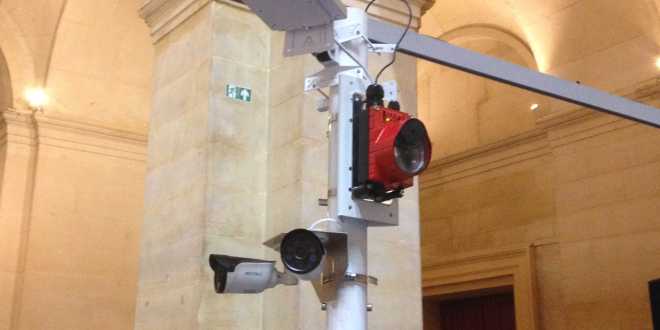
Light fidelity (Li-Fi) technologies are bringing illumination and communication capabilities that will both complement and, in many ways, surpass today’s wireless Wi-Fi systems.

In the late 1800s, Thomas Edison’s incandescent light bulb glowed for the first time. Within the next decade or so, Guglielmo Marconi’s wireless telegraph ushered in the era of radio frequency (RF) communication. But it wasn’t until the 1960s, with the advent of semiconducting LEDs, that these two foundational technologies could be effectively combined into one. Today, it is possible to use LEDs to provide illumination as well as to communicate via visible range wireless signals.
Data at the speed of light
Light fidelity, or Li-Fi, is a visible light communication (VLC) system first introduced in 2011 by Harald Haas, a researcher from the University of Edinburgh. The system utilizes LEDs, which emit visible spectrum light with brightness that can be precisely controlled and modulated at very high speeds — so quickly that the light pulses go undetected by the human eye. Thus, users benefit from the seemingly unflickering illumination of Li-Fi-enabled LED light bulbs, while data is simultaneously transmitted at speeds potentially faster than Wi-Fi. A basic VLC system consists of an intensity-controlled light source and at least one receiver device with a light detector (photodiode) input into a chip that communicates with a PC or a mobile device (Figure 1).
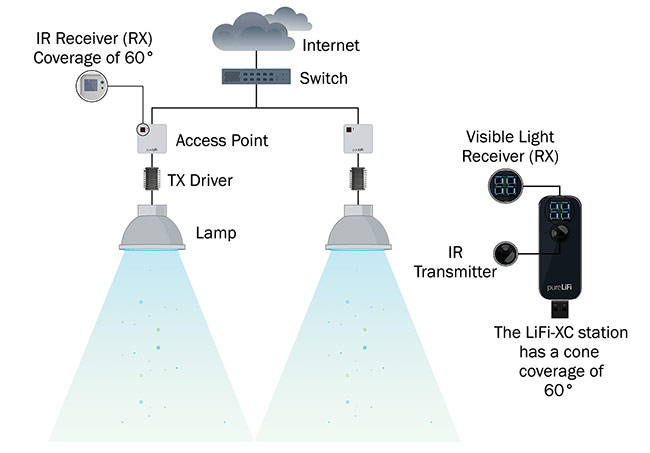
Figure 1. A Li-Fi-enabled LED lamp contains a transmitter (TX) that sends out rapidly changing visible light to a receiver (RX), shown here as a computer dongle (USB connection). A commonly used IR transmitter can send wireless data back from the PC to an IR receiver on an access point connected to the internet or a cloud-based network. Courtesy of pureLiFi.
Read the whole story at, “Photonics Media.”
Discover more from JB Systems Media and Tech
Subscribe to get the latest posts sent to your email.